

The Gospel (Good News) is wonderfully straightforward for those who wish to receive Jesus as Savior, and gain eternal life.
No religion can save you. Only Jesus can save. All religion is man’s attempt to break through to God. The message of the Cross is that God, through Jesus Christ, is breaking through to you. Religion is bondage. The cross of Christ is freedom.
Your relationship with Jesus Christ has two distinct facets: finding (believing) and following. This article will help you understand the first facet – what it means to find/believe in Jesus Christ for salvation. Remember that there is no way to follow Jesus unless you have first found Him.
Belief. This is something that happens literally in a moment of time. Spiritually speaking, at the moment you believe in and receive Jesus Christ, the new birth occurs inside you. Your spirit – the essence of who you are – is born again. Instantly, your spirit is restored in relationship to the Spirit of God, the Holy Spirit. Although your heart, mind, soul, and physical body (flesh) are still controlled by your sinful nature, your spirit is alive again! You are now in the family of God, the perfect righteousness of Jesus Christ covers you before a Holy God, and you are now saved for eternity! You know that you know that you know where you will spend eternity. You are guaranteed entrance into heaven, your eternal home.
Decision…or response?
So, you may ask, do I have to “make a decision” to believe in Jesus?
It’s not really a decision that you make. This may surprise you. Better stated, when you authentically believe in and receive Jesus Christ as your savior, it’s actually your response to a conviction that who Jesus claims to be – and what He promises to all who believe – is indeed true. This conviction is the Spirit of God drawing you! Because the drawing of God is internal, it’s most likely something you won’t at first attribute to God, but you’ll naturally think that you “made a decision.” It’s a transaction of the heart and mind that takes place as you respond. Of course, you’ll know you’ve responded and will confess that you now believe in Jesus!
For a better understanding, let’s look at Scripture in just one of the five letters written by the Apostle John. Remember that the New Testament is essentially a collection of personal letters written by people close to Jesus in the first century A.D. Most of these writers were in the original group of twelve disciples (called Apostles) that first believed in and then followed Jesus.
In the letter called the Gospel of John, he recorded an encounter involving a group of people and Jesus. Many people had been following Jesus around the countryside because He was performing miracles among them. Quite naturally many of them were at least curious. At some point, religious people in the crowd began to express objections to what Jesus was saying about Himself, namely that He was equal to God and could offer eternal life to those who believed in Him. The dialog we want to focus on here is really about this scriptural, first-century invitation to eternal life Jesus offered to all who would listen and believe. In so many words He told them, it wasn’t about a “decision” or effort that they were supposed to make! Rather, He instructed, it was the work of God alone that anyone could believe in Him in the first place.
What John testified to was that some people present in that conversation with Jesus pridefully refused to acknowledge His claims. They were blinded because of pre-conceived notions, religious thinking, human nature, doubts and even hatred of Jesus. They literally saw Him standing in front of them, heard Him speaking, yet hardened their hearts. Take a look at this important claim Jesus made, according to John’s account:
“The work of God is this: to believe in the one He has sent. (John 6:29) …As I told you, you have seen me and still you do not believe.” (6:36)
So Jesus recognized that they only saw Him in a way they wanted, and refused to respond to something deeper within themselves. They relied on their own thinking. In the bold statement from Jesus, quoted below, He turned the tables on the skeptical, stubborn crowd that didn’t see Him for who He claimed to be. It was not about them at all! There was nothing they could do in their own intellectual decision making that would bring them to belief and eternal life. It would only be possible by a work of God in them by which they would receive and believe – an inner conviction that His words were true. There was no other way.
“No one can come to me unless the Father who sent me draws them…” (6:44)
Now with the conversation shifted to God’s work to draw them, next came a passionate plea for their response in ways that may have seemed foreign to their ears, from the One who was there to save them:
“…Everyone who has heard the Father…comes to me (6:45) …Everyone who looks to the Son and believes in him shall have eternal life….” (6:40)
In the passage above it’s important to catch three postures in the response that distinguished between those who willingly received and were convinced of the truth (believers) and those who turned away in unbelief.
- One posture of the listeners’ response in John 6:45 was to really hear – to recognize the words of Jesus standing in front of them, as the words of God Himself. This “hearing” would refer to active listening, being keenly receptive to his words as being true.
- Another posture was to “come to” Him upon hearing, a metaphorical reference to the “action” of being willing to follow, trusting that He could show them the way to eternal life.
- A third posture of those convinced was to see Jesus in a different way – to “look to” Him, more than merely seeing; meaning in a sense acknowledging His call, His identity, and “turning” attentively toward Him. In this passage it’s important to notice that Jesus referred to Himself as “the Son.” In John’s writing, the S is capitalized, making an important statement. Now it was no longer about people seeing Jesus as just another teacher, or prophet, or “cult” leader as the doubting, jeering crowd saw Him. It was no longer about hearing and seeing only what they wanted, but about hearing His words, coming and looking to Him as the Son of God.
All of these inner postures are inherent in the response that demonstrates a conviction and trust (belief in), made possible only by the drawing power of God Himself! This inner response of the heart and mind is still the way to eternal salvation, and not a mere human, intellectual decision to believe.
In the next few words, Jesus made a final plea to the crowd, to leave the prideful debate behind, to humbly open their hearts and seek that deeper response, by the Spirit of God, to receive what He could be trusted to deliver.
“Stop grumbling among yourselves…Very truly I tell you, the one who believes has eternal life.” (6:43, 47)
Finally, perhaps still in the midst of the crowd another of Jesus’ apostles named Peter boldly affirmed that he and a small number of others had already come to believe in Jesus for who He claimed to be, the Son of God, perhaps setting an example to encourage others.
“Simon Peter answered him, ‘Lord, to whom shall we go? You have the words of eternal life. We have come to believe and to know that you are the Holy One of God.'”(6:68-69)
Thankfully some theologians today correctly understand this simplicity of saving faith (belief) that has never changed since that first century encounter recorded by John, i.e. what it takes for anyone to receive God’s greatest gift.
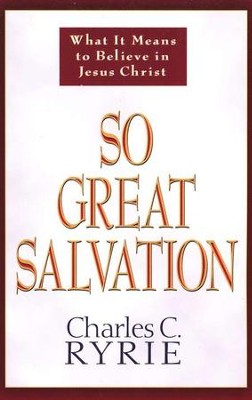
A respected theologian and author of the Ryrie Study Bible, Charles C. Ryrie, lays out the Gospel in a poetic form:
“God does it (John 1:13)
according to His Will (James 1:18)
through the Holy Spirit (John 3:5)
and the washing of regeneration (Titus 3:5)
when a person believes (John 1:12)
the Gospel revealed in the Word. (I Peter 1:23)”
– Taken from So Great Salvation, Moody Publishers, 1997, p. 128
Click on book cover to order
We’re closely aligned with Grace Evangelical Society (https://faithalone.org/beliefs/), which describes the Gospel message this way:
“The sole condition for receiving everlasting life is faith alone in the Lord Jesus Christ, who died a substitutionary death on the cross for man’s sin and rose bodily from the dead (John 3:16-18; 6:47; Acts 16:31).
“Faith is the conviction that something is true. To believe in Jesus (‘he who believes in Me has everlasting life’) is to be convinced that He guarantees everlasting life to all who simply believe in Him for it (John 4:14; 5:24; 6:47; 11:26; 1 Tim 1:16).
“… This saving transaction between God and the sinner is simply the giving and receiving of a free gift (Eph 2:8-9; John 4:10; Rev 22:17 ).”
Finally, Pastor Josh Poole beautifully and simply relates the salvation experience to a transaction of the heart, similar to the above quote from G.E.S.
“Maybe in this moment, in this place, today, the Holy Spirit spoke to you. And maybe upon opening up God’s Word you have had a transaction take place in your own heart and you have said, ‘I believe in Jesus.’ If that’s you, and you’re in here today, even without having said the prayer, I want you to know that you are saved.” – Pastor Josh Poole, Mission City Church
Now here are a few verses in God’s Word regarding the simplicity of the Gospel:
For by grace you have been saved through faith, and that not of yourselves; it is the gift of God, not of works, lest anyone should boast. Ephesians 2:8-9
For God so loved the world, that he gave his only Son, that whoever believes in him should not perish but have eternal life. For God did not send his Son into the world to condemn the world, but in order that the world might be saved through him. John 3:16-17
These things I have written to you who believe in the name of the Son of God, that you may know that you have eternal life. I John 5:13
Return to the previous page, A special relationship

Proudly powered by WordPress